POWER-DEPENDENT CARE / 09
Build the medical-device outage plan before buying another battery.
The useful number is not the battery capacity on the box. It is the tested time your exact care routine can continue—and the reserve you will not spend before calling, switching, or leaving.
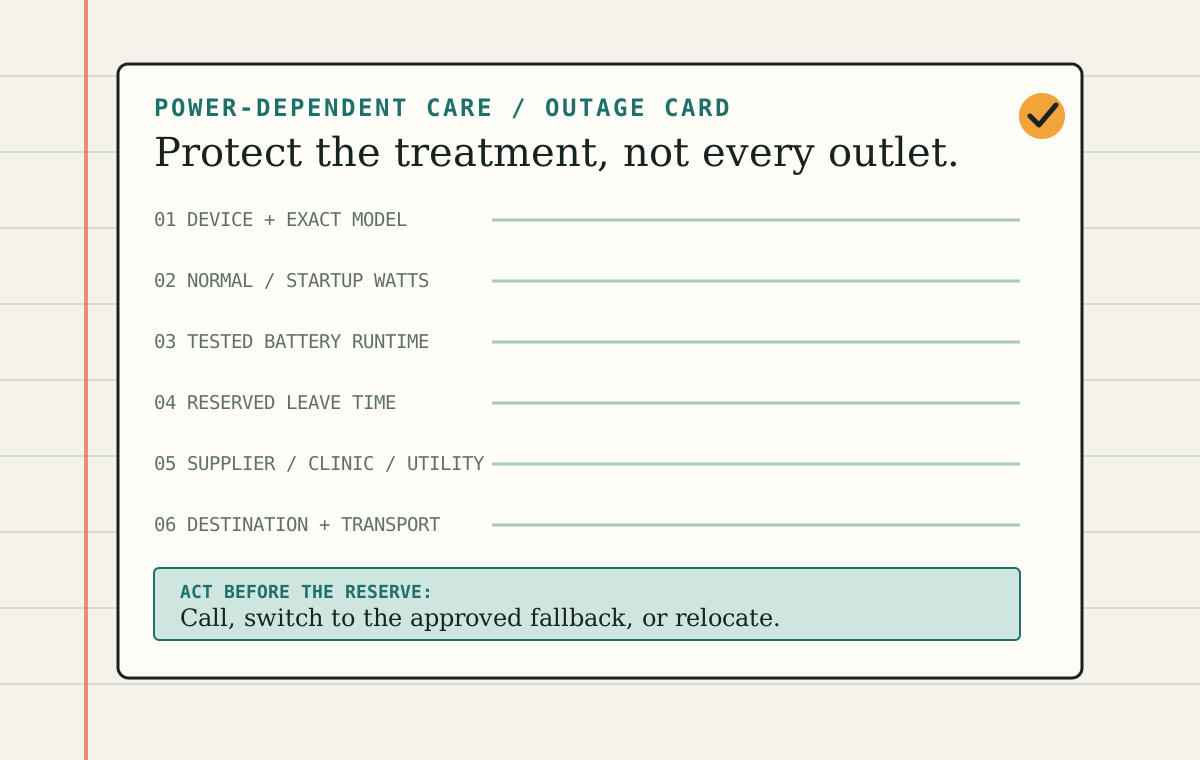
People searching for “medical equipment power outage” tend to arrive with the same urgent uncertainties: whether a battery can run an oxygen concentrator overnight, whether a positive airway pressure machine can use a portable power station, whether a utility priority list guarantees restoration, and how soon to leave home. Public discussions add practical friction—missing adapters, depleted batteries, humidifiers that increase demand, alarms that wake nobody, and backup equipment that has never been used—but they cannot establish what is safe for a particular patient or device.
A reliable plan begins with the exact model and its instructions for use. The U.S. Food and Drug Administration tells home-device users to know whether a device has a backup system, how long it operates, what other power source is permitted, whether a short interruption could cause harm, and whom to call. The agency also recommends a separate booklet for each device and help from the health professional managing the care. That is the right scale: one device, one routine, one tested fallback, and one decision owner.
Start with the consequence, not the wattage
Put every powered health support on the personal-needs dependency map: ventilator, oxygen concentrator, suction equipment, infusion pump, enteral feeding pump, dialysis equipment, powered mobility, lift, pressure-relief surface, communication aid, hearing-device charger, medicine refrigerator, monitoring equipment, and the phone or internet connection used to reach help. Record supporting loads such as a humidifier, heated tubing, water pump, or charger. A device can remain powered while the care routine fails because a companion supply or accessible transfer path was overlooked.
For each item, ask the clinician or supplier a direct consequence question: What happens if this stops for five minutes, thirty minutes, two hours, or overnight? The answer determines priority. A comfort load and a time-critical therapy do not belong in the same tier merely because both use electricity.
| Tier | Meaning | Planning action |
|---|---|---|
| Immediate | Interruption can quickly create a life-threatening or serious health risk. | Use the clinician-approved fallback and emergency call path immediately; do not wait for a utility estimate. |
| Time-limited | A short interruption may be tolerated, but the safe window is individual and finite. | Write the professional’s limit, preserve a relocation reserve, and act before that reserve begins. |
| Supportive | The load protects mobility, communication, positioning, monitoring, or comfort. | Plan lower-power alternatives without letting the support failure create a transfer, fall, or communication emergency. |
Do not invent the time limit. Write the answer in plain language, including what symptom, alarm, reading, or missed function means the plan has escalated. If the answer is unknown, that blank is the first task—not a reason to buy a larger battery.
Make a one-device fact sheet
Copy facts from the label and current instructions, then confirm them with the supplier or manufacturer. Model names that sound alike can require different adapters, batteries, or operating conditions. FDA guidance for home-use devices specifically addresses power sources, outlets, backup power, expected backup duration, surge protection, emergency contacts, and alternative ways to provide similar treatment. Keep the instructions beside the device and save an offline copy.
Device fact sheet
Device / purpose: _____________________________________________________
Manufacturer / exact model / serial: ___________________________________
Supplier and after-hours number: _______________________________________
Clinician and after-hours direction: ____________________________________
Input voltage, rated watts or amps: _____________________________________
Startup demand or special waveform: ___________________________________
Approved battery, adapter, inverter or generator connection: ______________
Alarm meaning and response: ___________________________________________
Permitted temperature, moisture and ventilation range: __________________
Clinician-approved nonpowered or alternate fallback: _____________________
Compatibility deserves an explicit yes or no. A connector that fits is not proof that voltage, current, waveform, grounding, startup demand, charging behavior, moisture protection, or oxygen-related fire precautions are acceptable. Do not build or improvise a medical-device power cable. Do not disable an alarm to save energy. If oxygen is in use, follow the supplier’s fire-safety instructions and keep flames and sparks away.
Measure the care routine as a load
Use the existing backup-power load budget, but give health loads their own table. Record watts while the device performs its normal cycle, not only at idle. If the setup includes heat or a compressor, note peaks and cycling. A plug-in meter can help only when the manufacturer permits that connection and the meter is rated for the load. Otherwise, use the manufacturer’s data and ask the supplier.
Energy is power multiplied by time. A device averaging 60 watts for eight hours uses about 480 watt-hours before losses. But a battery advertised as 500 watt-hours will not necessarily deliver 500 usable watt-hours to that device. Conversion losses, battery age, cold, protective cutoffs, startup demand, accessory loads, and manufacturer limits all matter. Treat arithmetic as a screening estimate and a supervised test as the evidence.
| Load state | Watts or amps | Hours per day | Energy / supply | Source |
|---|---|---|---|---|
| Normal therapy | _____ | _____ | _____ Wh | Label / manual / permitted measurement |
| Accessory or heat | _____ | _____ | _____ Wh | Manual / permitted measurement |
| Startup or peak | _____ | seconds / cycles | _____ W peak | Manufacturer / permitted measurement |
| Communication | _____ | _____ | _____ Wh | Charger label / measurement |
Test without interrupting care
Plan the test with the clinician or supplier when interruption is dangerous. Run it in ordinary conditions with the approved battery and cables, actual settings, usual accessories, and a fully charged communication device. Keep normal utility power available so the test can end safely. Do not perform a first test during severe weather.
- Inspect and charge. Check the battery, cables, filters, vents, alarms, expiration dates, and current instructions.
- Write the stop rules. Name the battery percentage, alarm, device behavior, symptom, or elapsed time that ends the test.
- Start a log. Record time, battery indicator, device mode, accessory state, room temperature, and any alarm every 30 or 60 minutes.
- End before depletion. Restore normal approved power at the planned stop point. Do not learn the absolute limit by risking treatment.
- Recharge and review. Time the recharge, confirm settings did not reset, and note what would change in cold weather or a longer outage.
The result is a tested planning runtime, not a guarantee. Batteries age. Equipment settings change. Cold reduces some battery performance. Repeat the check on the schedule in the equipment instructions and after a battery, device, prescription, accessory, caregiver, or destination changes.
- Care clock: tested time the approved setup can support the routine.
- Decision clock: time remaining before calling, changing to the approved fallback, or relocating.
Do not spend the decision reserve as ordinary runtime. A person, wheelchair, equipment, supplies, and oxygen may take much longer to move than a packed car.
Build the call ladder while phones work
FDA advises users to keep emergency numbers for the supplier, home-care agency, doctor, and manufacturer, including after-hours numbers. Put those numbers on paper beside the device. Add the utility outage line, local emergency management or public health contact, transport provider, building manager where relevant, and two accessible destinations.
- Immediate danger: emergency services and the clinician-directed emergency action.
- Device problem: equipment supplier or manufacturer support, then the treating team as instructed.
- Outage information: utility report and estimate, while remembering estimates can change.
- Relocation: destination, transport, caregiver, building access, and a backup driver.
Ask whether the utility or local agency offers a medical-needs registry, notification program, or voluntary emergency planning service. Register if useful, but never interpret registration as a promise of uninterrupted power, priority restoration, a generator, or rescue. The independent reserve and relocation plan still have to work.
Choose a destination that can support the device
“Go to family” is not yet a plan. Confirm that the location is open, reachable, accessible, and equipped with the correct electrical service. Ask whether it can support oxygen safety, refrigeration, water, sanitation, charging, transfer space, sleeping position, service animals, and the length of stay. A public shelter or warming center may not provide medical care or every power connection; verify capabilities with local officials before relying on it.
Pack the device, exact cables and adapters, current instructions, consumable supplies, medications, batteries, approved extension equipment, a paper contact list, identification, insurance information, and a concise care summary. Keep health information private and carry only what is needed. Use the winter stay-or-go plan to combine the device clock with road conditions, indoor temperature, destination status, and loading time.
Use generators only through a safe, approved plan
The Centers for Disease Control and Prevention says portable generators belong outdoors, more than 20 feet from windows, doors, and vents, with battery-powered or battery-backup carbon monoxide detectors in the home. Never run one in a house, garage, basement, carport, shed, or other enclosed or partly enclosed space. Keep it dry without operating it in an enclosure, and use outdoor-rated cords as directed.
A generator does not settle medical-device compatibility. Confirm the connection and power quality with the manufacturer or supplier, and have permanent wiring installed by a qualified electrician. Never backfeed a home through a wall outlet. If oxygen or another fire-sensitive therapy is present, follow the supplier’s separation and fire-safety instructions.
Write the trigger, not “when the battery is low”
Vague triggers fail under stress. Tie the decision to a measured reserve and a concrete next action. An example structure is: “When the approved battery reaches ___ percent or ___ hours remaining—whichever comes first—Alex calls the supplier and destination. If utility restoration is not confirmed inside the usable window, we switch to the clinician-approved fallback or leave by ___.” The actual numbers and treatment path must come from the specific care plan.
Outage action card
Power fails: confirm the device state, start the log, and report the outage.
Call trigger: __________________________________________________________
Approved fallback trigger and action: ___________________________________
Leave trigger / reserved runtime: _______________________________________
Destination A / B and confirmed capability: ______________________________
Transport, loading time and helper: _____________________________________
Emergency action if the device stops or symptoms appear: _________________
Decision owner / backup: ______________________________________________
Questions to resolve before the next outage
How long will a battery run the device?
Start with the exact instructions and approved battery, then test the care routine under safe normal conditions. Rated capacity divided by watts is only a rough screen. Preserve a separate decision reserve and retest as equipment and batteries age.
Can a portable power station run it?
Possibly, but the product category does not prove compatibility. Confirm voltage, waveform, grounding, peak demand, adapter, charging, environmental limits, and restrictions with the manufacturer, supplier, and care team.
Will a utility medical list protect me?
It may provide notifications or help local planning where offered. It cannot guarantee service or restoration time. Keep an independent fallback, call ladder, transport plan, and destination.
What if the device resets after power returns?
FDA advises checking that settings have not changed after an interruption. Follow the instructions for use and contact the supplier or clinician if anything is unfamiliar. Do not guess at prescribed settings.
Primary sources checked
- FDA — Home Health and Consumer Devices — current home-device resources and the power-outage planning booklet.
- FDA — How to Prepare for and Handle Power Outages for Medical Devices that Require Electricity — device information, backup questions, contacts, supplies, and actions.
- FDA — Home Healthcare Medical Devices: A Checklist — instructions, alarms, backups, batteries, contacts, and caregiver practice.
- FDA — Medical Devices and Natural Disasters — wet equipment, restored power, settings, oxygen, and generator precautions.
- CDC — Power Sources — backup power, medical equipment, outdoor-rated cords, and CO alarms.
- CDC — Carbon Monoxide Poisoning Basics — generator distance, enclosed-space prohibition, and detector guidance.
- CMS — Core Emergency Preparedness Rule Elements — risk assessment, equipment failure, communication, and testing concepts.
Sources reviewed November 5, 2026. Public discussions were used to identify repeated questions about battery sizing, CPAP accessories, oxygen concentrators, utility registries, adapters, and relocation timing. Device and health claims were resolved against FDA, CDC, and CMS guidance. Follow current instructions for the exact device and the individual clinical plan.