Power planning / 06
Build a backup-power load budget before buying a battery.
A large capacity number does not tell you whether a power station can start the refrigerator, support a medical device for the night, or remain light enough to move. Begin with the outcomes your household cannot lose, measure the exact loads, and test the smallest safe system that covers them.
Public questions about backup batteries often begin with a product: “Will this 500-watt station run my CPAP?” or “How many watt-hours do I need for a refrigerator and router?” The product number is too early. The answer changes with the exact device, settings, cycling, startup demand, temperature, battery condition, conversion path and number of hours that matter.
A useful load budget separates three decisions. Power asks whether the station can operate the connected equipment at a given moment. Energy asks how long the stored charge can support it. Consequence asks which loads deserve scarce capacity first. The last question keeps a household from spending heavily to copy normal life when a smaller system could protect health, communication, safe light and a planned cold-storage decision.
Start with the consequence, not the appliance
Write what must continue, then name the device that currently provides it. “Maintain breathing support during sleep” is a consequence. “Run the CPAP” is one device-based control. “Receive local warnings” is a consequence; a phone, weather radio and paper contact tree are different controls. This wording exposes alternatives before capacity becomes a shopping contest.
| Necessary outcome | Primary electric load | Non-electric or relocation fallback | Decision deadline |
|---|---|---|---|
| Operate prescribed medical support | Exact device, settings and approved accessories | Clinician-approved backup, support contact, powered destination | Before the verified battery reserve is reached |
| Receive alerts and make calls | Phone, radio, modem only if local service remains | Battery radio, paper numbers, check-in point | Before communications or phone charge fails |
| Move safely after dark | LED task light or rechargeable lantern | Primary batteries and daylight staging | Before stairs and exits become unsafe |
| Protect food or medicine | Refrigerator, freezer, medical refrigerator | Closed-door time, tested cooler, ice source, relocation | From product-specific temperature guidance |
Give each outcome a priority: life safety, time-sensitive health, communication and safe movement, property or food protection, then comfort. Your order may differ because the consequences differ. A person who relies on a ventilator has a different first load from a household that can relocate easily. A renter on an upper floor may value a light and charged phone above a heavy refrigerator backup.
Keep the list short. A first system that attempts a furnace, electric range, water heater, clothes dryer, microwave, refrigerator, computers and entertainment will become large, expensive and hard to move. Whole-home equipment, transfer switches and building wiring belong with qualified professionals, permits and utility requirements. This worksheet is for portable, manufacturer-approved connections to selected loads.
Separate watts from watt-hours
The National Renewable Energy Laboratory defines power as the rate at which electricity is used, measured in watts, and energy as power over time, measured in watt-hours. The basic relationship is:
Energy budget
Watt-hours needed = measured watts × hours of operation
Example: a steady 20-watt load for 5 hours uses 100 watt-hours.
For several loads: calculate each row, then add the watt-hours.
Keep a reserve: real systems lose energy and change with conditions, so a calculated total is a starting point, not a runtime promise.
A station labeled “600 W / 512 Wh” is describing two different limits. The 600-watt figure usually describes continuous output: the rate the unit can supply. The 512-watt-hour figure describes stored energy under specified test conditions. One does not substitute for the other. Port-specific limits also matter; the USB-C port, vehicle-style socket and AC outlets may each have different ceilings even when the total headline output looks sufficient.
Do not use “watts per hour.” A watt is already a rate. Write watts for power and watt-hours for energy. This small language change prevents the most common sizing error: comparing a device’s watt rating directly with a battery’s watt-hour capacity as if they measured the same thing.
Measure the exact load and operating pattern
Begin with the device label and manual. Record voltage, current, rated watts, power-supply requirements, prohibited connection methods and any startup or peak information. For ordinary plug-in household equipment, a listed plug-in energy meter can show running watts and accumulated watt-hours when used within its rating and instructions. Do not open panels, modify cords, build adapters or place a meter where moisture or overload is possible.
The label is not always the operating average. A power adapter may show its maximum input. A refrigerator cycles on and off. A CPAP can change demand with pressure, heated humidity and heated tubing. A modem and router may be two separate loads. A device with a motor or compressor may require a brief startup demand above its running power.
- Steady load: measure the usual watts after startup and note any modes that change it.
- Cycling load: measure accumulated watt-hours over a representative period, ideally long enough to capture several cycles, then scale cautiously.
- Variable load: test the actual settings and environment expected during an outage.
- Motor or compressor: confirm both running power and startup compatibility from the equipment and station documentation.
- Medical load: use only the approved power path and the device-specific advice from the manufacturer, distributor and care team.
For refrigeration, a 24-hour measurement under normal use gives more useful energy data than multiplying the compressor’s running watts by 24. Even then, outage conditions can change door openings, room temperature and cycling. Food safety has its own clock: CDC advises keeping refrigerator and freezer doors closed during an outage and gives time-based guidance for when food remains safe. A battery plan should support that decision, not encourage repeated door opening to check.
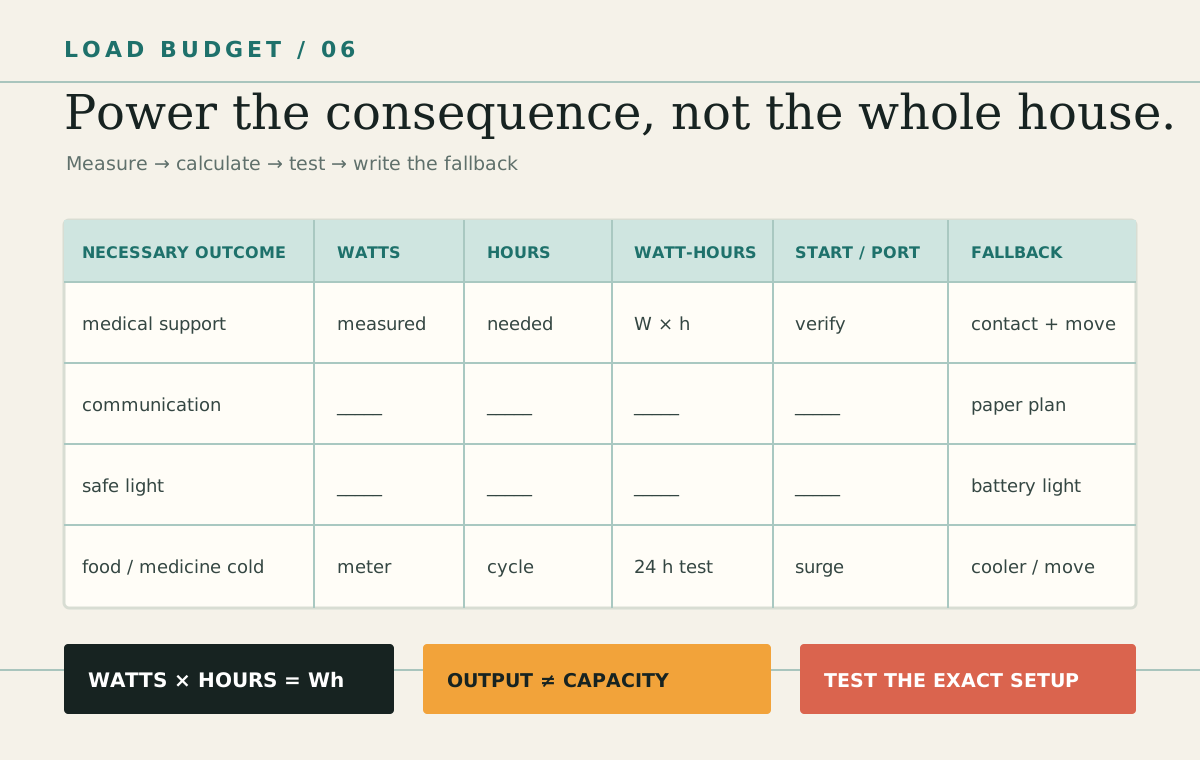
Build the six-column load budget
Use one row per essential load. Keep estimates visibly separate from measurements. If a number comes from a label, mark it “label.” If it comes from a meter test, write the test date, duration and settings. If the manufacturer specifies a limit, link or staple the source to the sheet.
| Load | Running W | Hours or duty cycle | Calculated Wh | Startup / compatibility | Fallback |
|---|---|---|---|---|---|
| Medical device | _____ source: _____ | _____ settings: _____ | _____ | Approved connection: _____ | Contact / destination: _____ |
| Phone and alerts | _____ | _____ | _____ | Port / cable: _____ | Radio / paper plan: _____ |
| Safe lighting | _____ | _____ | _____ | Charge method: _____ | Primary batteries: _____ |
| Cold storage | _____ | Measured Wh: _____ | _____ | Startup verified: _____ | Cooler / food plan: _____ |
Add the watt-hours for loads that must run during the target window. Then identify the greatest simultaneous running watts and every startup event. A station must satisfy both: enough usable energy for the window and enough compatible output for the loads that may operate together. Staggering ordinary loads may reduce simultaneous demand, but never switch off a necessary medical device or safety system to make a spreadsheet work.
Now add a planning reserve. There is no universal percentage that guarantees runtime. AC conversion, the station’s own electronics, small-load inefficiency, temperature, battery age, cable loss and automatic shutoff thresholds can all reduce energy delivered to the device. Treat advertised capacity as a comparison input. The full-load test determines the household number.
Check six constraints before comparing products
- Continuous output: the maximum simultaneous running load must fit the station’s output and the limit of the specific port being used.
- Startup demand: compressors, motors and pumps may briefly exceed running watts. Both the source and the appliance documentation matter; a “surge” headline without conditions is incomplete.
- Connection compatibility: voltage, connector, polarity, AC waveform, grounding instructions, cord rating and manufacturer approval must match. Never improvise a cable.
- Recharge path and time: record how the unit recharges, how long that takes under realistic conditions, and whether the source will actually be available during the outage.
- Weight and access: confirm that the person assigned can move, read, connect and maintain the unit. A high-capacity system that blocks an exit or cannot reach the needed room fails the household test.
- Safety and support: check current CPSC recalls, manufacturer instructions, warranty, service contacts and credible evidence of applicable safety certification. CPSC lists UL 2743 among the voluntary standards relevant to portable power packs.
Do not plan to run a portable battery where the manufacturer prohibits it, where it can get wet, where heat cannot dissipate, or where cords create a trip or exit hazard. Use the supplied or manufacturer-approved charger. Stop using a unit that is recalled, damaged, swollen, unusually hot, leaking, smoking or behaving abnormally, and follow manufacturer and local fire-department instructions.
Test the system without interrupting necessary care
A paper calculation cannot verify startup behavior, alarms, cables, settings, automatic shutdown, remaining-capacity display or actual runtime. Schedule a controlled test when utility power is available, another safe power source is ready, and stopping the test will not interrupt critical care. For a medical device, follow the care team and device instructions.
- Charge the station exactly as instructed and record the starting state.
- Place it in the intended safe location with the intended cables and clearances.
- Connect one approved load at a time and confirm normal operation, alarms and settings.
- Run the actual combination and usage pattern for a useful test window.
- Record starting and ending charge, elapsed time, delivered or measured watt-hours if available, room conditions and any fan, heat, noise or fault behavior.
- Calculate the observed rate only from this setup, then keep a conservative reserve.
- Recharge, inspect and return every device to normal service.
Repeat when equipment, settings, cables, household members or seasons change, and on the maintenance interval in the power-station instructions. A battery that sits untouched for a year is an assumption. Add its charge check to the fall changeover audit or another recurring household date.
Use load shedding as a decision tool
Load shedding means choosing which lower-priority use to pause so a higher-priority outcome lasts longer. Rank the rows before the outage. For example, a phone may charge briefly and then disconnect; an LED task light may replace several room lights; internet equipment may be unnecessary if the local service is down. Keep manual instructions on the sheet so nobody must invent priorities at 2 a.m.
Refrigeration needs a separate decision. Avoid cycling it from the battery without understanding startup compatibility and food-safety timing. A closed refrigerator and a tested cooler plan may protect the outcome with less energy. Similarly, a battery cannot provide practical space heat for long in most portable systems. Insulation, a safe heated destination and an early move may outperform trying to power an electric heater.
The load budget should always end with a fallback column. A battery can fail, be depleted, be recalled, or be inaccessible. Write the support contact, alternate location, transport plan and last safe decision time. For medical equipment, FDA recommends notifying the electric company and fire department that the home has a device needing power; local programs vary and registration does not guarantee priority restoration, so maintain an independent plan.
Three example calculations, without pretending they are guarantees
Example 1: communication and light
Suppose a measured communications setup averages 18 watts and is scheduled for six hours total, while one 6-watt LED light runs for five hours. The worksheet total is (18 × 6) + (6 × 5) = 138 watt-hours. That does not mean a 138-Wh battery is sufficient: capacity is not fully delivered, conditions vary, and charging the phone itself adds a load. Test the exact setup and retain a reserve.
Example 2: a cycling refrigerator
Do not calculate from a 150-watt running observation multiplied by 12 hours. Use accumulated watt-hours from a representative meter test, check the startup demand, and account for outage room temperature and door use. Compare that result with the food-safety plan and the value of protecting the contents. A cooler, ice, fewer door openings or moving priority items may be a better control.
Example 3: prescribed nighttime equipment
Do not copy a wattage from another person’s device. Heated accessories and therapy settings can change consumption, and an unapproved DC cable can create a safety or device risk. Ask the manufacturer or distributor for compatible backup options, preserve prescribed settings, and test the exact authorized configuration for the full needed period while normal power and qualified help remain available.
Run the 30-minute load-budget session
- Minutes 0–5: write three necessary outcomes and rank them by time to harm.
- Minutes 5–10: identify the exact devices, settings, cables and simultaneous-use pattern.
- Minutes 10–18: collect label data and existing meter results; mark every unknown instead of guessing.
- Minutes 18–23: calculate watt-hours for steady loads and enter measured energy for cycling loads.
- Minutes 23–27: check continuous output, startup demand, ports, recharge time, weight and safety constraints.
- Minutes 27–30: write the test date, reserve rule, load-shedding order and fallback trigger.
If the worksheet is mostly blank, the next action is measurement or an authoritative call, not a purchase. Use the personal-needs dependency map to identify health and support loads, the one-hour power-outage test to rehearse household handoffs, and the $50 preparedness ladder to compare a battery purchase with cheaper controls.
Sources checked
- National Renewable Energy Laboratory, Basics of Electricity and Energy, including power, energy and the watts × time relationship.
- U.S. Food and Drug Administration, Home Health and Consumer Devices, including the power-outage booklet for medical devices.
- FDA, Tips About Medical Devices and Natural Disasters.
- FDA, Frequently Asked Questions About Home Use Devices.
- U.S. Consumer Product Safety Commission, Batteries and High-Energy-Density Fire Safety Standards.
- U.S. Consumer Product Safety Commission, Recalls database.
- CDC, Keep Food Safe After a Disaster or Emergency.
- Ready.gov, Power Outages.
Public discussions were reviewed for recurring questions about CPAP runtime, refrigerators, routers, AC-versus-DC connections, startup demand and misleading capacity comparisons. Those discussions informed the questions addressed here; safety and medical directions come from the primary sources and device-specific instructions above.