WINTER OUTAGE / 08
Decide when to stay and when to leave before the house gets cold.
The useful question is not “How long will my home stay warm?” It is whether this household can remain safe, with this weather and this travel window, until heat returns.
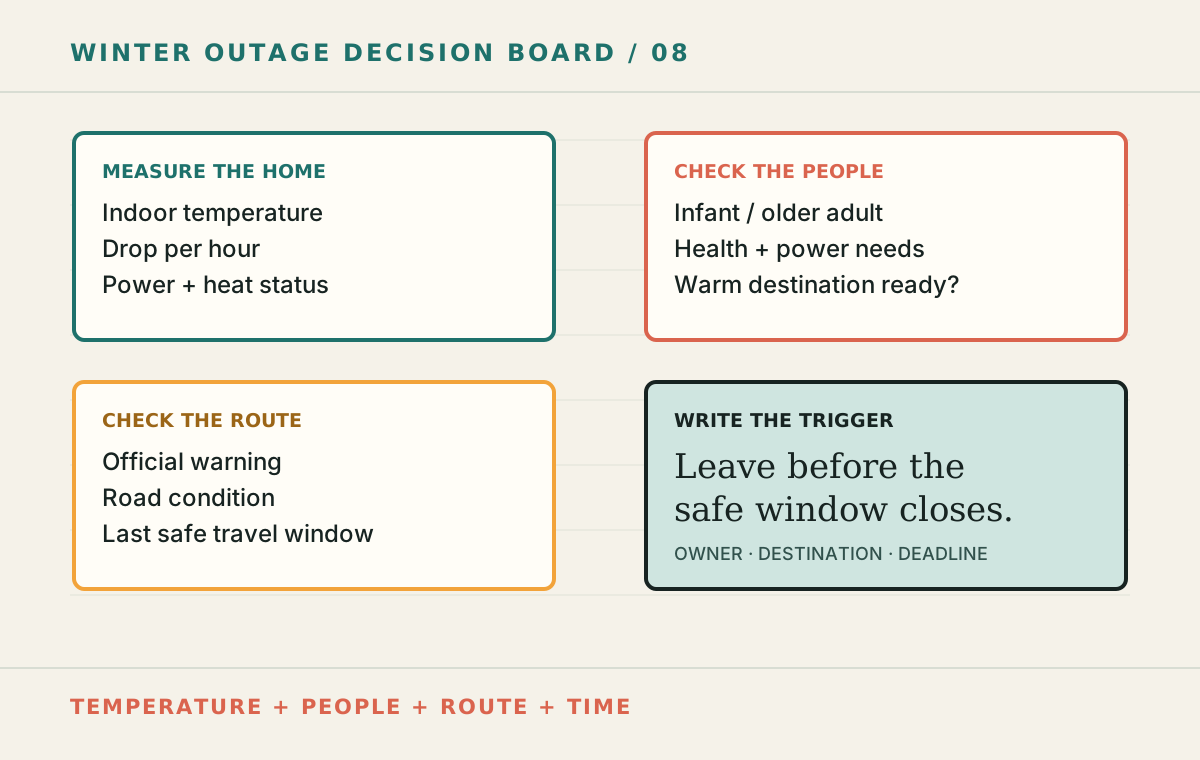
Searches and public discussions about winter outages usually ask for a number: how many degrees will a house lose per hour, what indoor temperature is unsafe, or how long a battery can run a furnace. Those questions reveal a real gap, but no universal number can answer them. Homes differ in insulation, air leakage, size, exposure, heating system, indoor mass, starting temperature, and outdoor conditions. Households differ in age, health, mobility, medications, equipment, clothing, transport, and access to a warm destination.
A better plan treats staying home as a time-limited decision. It combines five observations: indoor conditions, the people and animals present, the safety and duration of available heat, the official weather and road picture, and the last practical moment to relocate. The result is a written trigger, not a promise that a certain thermostat reading is safe for everyone.
Home trend + household vulnerability + safe heat + route + time determines the next action. If any one of those becomes critical, the plan changes before cold illness, carbon monoxide exposure, fire, or dangerous travel begins.
Why “wait and see” becomes risky
A winter outage can remove more than lights. Electric ignition, blowers, pumps, thermostats, well pumps, elevators, building entry systems, communication, medical devices, and fuel delivery may stop together. A gas furnace can still depend on electricity. A fireplace can be unusable because it has not been inspected. A warming center may open, but the route can deteriorate before the house reaches its coldest point.
The National Weather Service warns that a Winter Storm Warning can mean travel will become difficult or impossible. An Ice Storm Warning can signal dangerous travel and likely damage to power lines and trees. Those official products are decision inputs, not background reading. If the plan requires driving, the safe travel window can close long before the home reaches its lowest temperature.
CDC identifies babies and older adults as groups needing extra attention in extreme cold. Infants under one year lose body heat more easily and should not sleep in a cold room. Older adults may produce less body heat and should check indoor temperature often. People with cardiovascular, respiratory, endocrine, neurologic, mobility, or cognitive conditions, and anyone whose essential device or medication routine depends on power or temperature, may need an individualized plan from a clinician.
Step 1: map what the outage actually stops
Start with the personal-needs dependency map. Trace the heating system from fuel and electricity to the room where people sleep. Record every powered component: thermostat, ignition, circulation pump, blower, zone valve, condensate pump, pellet feed, well pump, elevator, stair lift, oxygen concentrator, communication device, refrigerator for medicine, and charger.
| System | What fails without power? | Current fallback | Time limit or trigger |
|---|---|---|---|
| Primary heat | Thermostat, ignition, blower, pump, controls, or fuel delivery | Only a professionally installed, maintained, approved path | Indoor trend and equipment instructions |
| Health routine | Device, charging, refrigeration, lift, water, or communication | Clinician-approved backup or warm accessible destination | Reserve remaining before relocation |
| Water and sanitation | Well pump, building pump, hot water, toilet refill | Stored water and sanitation plan | Minimum supply for travel delay |
| Building access | Elevator, powered door, garage opener, lighting | Accessible exit and manual release instructions | Leave before access is lost |
| Communication | Router, cell charging, cordless phone | Charged phone, radio, written contacts | Scheduled check-in if networks fail |
Do not count equipment as a fallback because it is stored in a box. Count it only when the model is appropriate for the intended use, installed or operated as required, maintained, fueled or charged, and usable by the person assigned to it. The backup-power load budget can test whether a battery or generator plan covers the exact loads that protect health and safe relocation.
Step 2: choose measurements you can read without the grid
Use at least one indoor thermometer that does not depend on the home internet or a cloud service. Put it in the occupied room, away from direct sunlight, exterior drafts, the stove, fireplace, or other local heat. A second reading in the coldest necessary room can reveal a faster problem, but avoid creating a complicated monitoring system nobody will use.
At the start of an outage, record the time, indoor temperature, outdoor conditions from an official source, occupied rooms, primary heat status, backup status, and utility estimate if one exists. Repeat indoor readings on a schedule appropriate to the conditions—more often when temperature is dropping quickly, a high-risk person is present, or safe travel may close.
The rate of change is evidence about this outage, not a permanent rating for the building. A sunny afternoon, calm night, open door, wind shift, or much colder outdoor temperature changes heat loss. Do not extrapolate a short reading into an all-night guarantee. Use it to decide whether the available margin is shrinking faster than the household can safely respond.
First-hour observation log
Outage began: ______ · utility estimate: ____________________
Indoor temperature: start ______ · later ______ · elapsed ______
Outdoor conditions and official warning: ________________________
Occupied safe room: ______ · dry layers / blankets ready: yes / no
Essential power reserve: ______ hours tested · leave reserve: ______
Road and destination checked at: ______ · next check: ______
Step 3: set a person-specific cold plan
There is no single indoor temperature that is safe for every person. The plan should be more conservative when it includes an infant, older adult, someone who cannot reliably sense or communicate cold, a person with a health condition affected by cold, a power-dependent medical routine, limited mobility, wet clothing, or no warm sleeping system.
Ask a clinician what conditions or interruptions require earlier relocation for a specific health need. Record observable triggers, such as “leave while the lift and vehicle can operate when battery reserve reaches the written amount,” rather than a vague instruction to leave if someone feels cold.
Know the signs of hypothermia. CDC lists shivering, exhaustion, confusion, fumbling hands, memory loss, slurred speech, and drowsiness in adults; babies may have bright red, cold skin and very low energy. Hypothermia is a medical emergency. Do not use symptom onset as the planned decision threshold. Call emergency services for suspected hypothermia and follow current first-aid guidance while help is coming.
The stay-or-go card should move the household earlier. If anyone develops confusion, unusual drowsiness, loss of coordination, slurred speech, or other signs of cold illness, seek emergency help.
Step 4: retain heat without creating a new hazard
Dry clothing, loose layers, hats, blankets, and sleeping bags reduce personal heat loss. Choose one occupied room that can be closed off without blocking a required exit, smoke alarm, carbon monoxide alarm, or ventilation path. Close curtains at night, reduce drafts with ordinary weather sealing, and limit unnecessary door opening. Keep food, water, medicines, lights, radio, chargers, and pet supplies in reach so people do not repeatedly move through cold areas.
Those measures slow heat loss; they do not replace safe heating or a relocation plan. Do not seal a room so tightly that required ventilation is blocked. Do not improvise a tent around a heater, run an extension cord under bedding, or crowd combustible material around a heat source.
Follow the current instructions for every heater, fireplace, stove, chimney, battery, and generator. CPSC and EPA warn never to use a gas oven or range, grill, camp stove, dryer, or other unvented combustion appliance to heat the home. Never run a portable fuel generator inside a home, garage, basement, crawlspace, shed, porch, or carport. CPSC says to operate it outdoors at least 20 feet from the home, with exhaust directed away from buildings, windows, doors, and vents, while following the manufacturer’s weather and electrical-safety instructions.
Keep battery-operated carbon monoxide alarms or alarms with battery backup working on every level and outside sleeping areas, following manufacturer instructions and local codes. Test smoke and CO alarms monthly. If a CO alarm sounds, or people develop headache, dizziness, weakness, nausea, shortness of breath, or confusion that could be exposure, move to fresh air and call emergency services. Do not search for the source first.
Step 5: verify the destination before you need it
A plan to “go to family” is incomplete. Confirm the destination has heat, power, space, accessible entry, safe parking, compatible medical support, permission for pets or service animals, and a route that remains open. Name an alternate in a different part of the service area when practical.
- Destination A: address, contact, heat source, outage status, access, pet policy, sleeping plan.
- Destination B: same details, preferably outside the same local failure.
- Public option: local emergency-management contact and how warming-center openings are announced.
- Transport: driver, vehicle, fuel or charge, car seats, mobility equipment, and pickup point.
- Arrival kit: medicine, documents, chargers, water, warm layers, accessibility supplies, pet items, and handoff notes.
Call or check an official source before leaving. A warming center may have limited hours, transportation, accessibility, medical support, or animal accommodations. A hotel may also be inside the outage. Record what you verified and when.
Step 6: protect the last safe travel window
Travel can be more dangerous than staying in a stable, warm home. It can also be safer to relocate before icing, heavy snow, darkness, falling trees, or extreme wind chill arrives. The decision must compare both sides, using current local information.
Monitor the National Weather Service forecast office, state or local road agency, utility, emergency management, and destination. A Winter Storm Watch is time to review the decision card and pre-position the kit. A warning, falling indoor temperature, uncertain restoration time, or deteriorating route can move the leave-by time earlier. Follow evacuation orders immediately.
Do not set the deadline at the moment the home becomes intolerable. Set it early enough to load people, equipment, pets, and supplies in daylight or before the forecast route hazard, with a reserve for delay. A household with a wheelchair lift, infant, home oxygen, anxious pet, or rural drive may need much more loading time than an able-bodied adult traveling alone.
If the plan still depends on a safe road, working elevator, charged lift, warm destination, daylight, or a helper, act before that resource is expected to disappear. The final margin belongs to delays, not to waiting.
Write three levels instead of one vague threshold
| Level | Observed condition | Action |
|---|---|---|
| READY | Watch issued, outage possible, heat or travel vulnerable | Charge devices, test alarms, verify destinations, fuel vehicle, stage warm kit, identify carrier |
| DECIDE | Outage begins, indoor trend worsens, restoration uncertain, warning issued, road window narrowing | Start observation log, contact destination, compare reserve with loading and travel time, set leave-by clock |
| LEAVE / CALL | Written trigger reached, heat or medical backup approaching reserve, official evacuation, unsafe equipment, CO/fire concern, or cold-illness signs | Relocate while route is usable or call emergency services when immediate danger or transport barrier exists |
Your trigger might combine conditions: “If heat is not restored by 7 p.m., indoor temperature is still falling, and the county route remains open, Alex starts loading at 7:15 and leaves by 7:45 for Destination A.” A household-specific health trigger may require leaving earlier. Never let a utility restoration estimate override the conditions you can observe.
Run a tabletop drill, not a cold-house experiment
Do not shut off essential heat in dangerous weather or interrupt medical care to test this plan. Use a tabletop drill and the one-hour power-outage test with normal safety systems available.
- Choose a plausible forecast and outage start time.
- Read the thermometer and locate the paper weather, utility, road, and emergency contacts.
- Call the destination and confirm the information the plan requires.
- Find warm clothing, medicine, mobility equipment, documents, pet supplies, lights, and chargers.
- Time loading without moving the vehicle in unsafe conditions.
- Ask the backup decision-maker to explain the READY, DECIDE, and LEAVE triggers.
- Record every missing item, login, access barrier, and unclear responsibility.
Use real heat-loss data only when an ordinary outage or safe, professionally guided maintenance event provides it. Record outdoor and indoor conditions without creating exposure. Treat the result as one observation, then keep the decision margin conservative.
Optimize the plan for the household’s constraint
When money is tight, the first upgrades are often information and control: a reliable thermometer, tested smoke and CO alarms, draft repair, dry layers, a verified destination, a written utility number, and a full vehicle fuel or charge plan before a storm. If storage is tight, prioritize wearable warmth, one sleeping system per person, essential medication, light, and a compact relocation kit.
If time is tight, write the destination and leave-by trigger first. If mobility is the constraint, test the exit, elevator alternative, transfer, vehicle loading, and accessible destination. If power is the constraint, protect essential health and communication loads with the load budget. If several gaps compete, rank them with the household risk audit instead of buying the largest advertised heater.
Complete the one-page decision card
Winter outage stay-or-go card
People and cold-sensitive needs: ________________________________________
Primary heat dependency: ______________________________________________
Safe backup heat and limits: ___________________________________________
Indoor thermometer locations: _________________________________________
Essential power reserve / leave reserve: _________________________________
Destination A / B: ____________________________________________________
Driver, vehicle, access and loading time: _________________________________
Official weather / road / utility contacts: ________________________________
READY trigger: ________________________________________________________
DECIDE trigger: _______________________________________________________
LEAVE or CALL trigger: ________________________________________________
Decision owner and backup: ____________________________________________
Questions the plan should answer
How cold is too cold to stay?
No single number fits every person and building. Use the indoor trend, health and age-related vulnerability, safe heat, power reserve, symptoms, restoration information, and safe travel window. Ask a clinician for person-specific limits when health is affected by cold or an outage.
Can a gas stove or oven heat the home?
No. EPA and CPSC warn against using gas ovens or ranges for space heat because of carbon monoxide and fire risk. Grills, camp stoves, dryers, and portable fuel generators also do not belong indoors.
Should we move everyone into one room?
Concentrating normal body heat and supplies in one closable room may reduce the space you need to manage, provided the room keeps required ventilation, alarms, and exits clear. It does not make unsafe combustion equipment safe or replace relocation when conditions deteriorate.
When should we leave?
Leave while the route and destination are usable when the written trigger is reached, essential backup approaches its reserved limit, safe indoor conditions cannot be maintained, an official evacuation is issued, or fire or CO danger appears. Call emergency services when immediate danger or transport barriers prevent safe relocation.
Primary sources checked
- CDC — Safety Guidelines During and After a Winter Storm — indoor safety, infants, older adults, safe heating, and winter travel.
- CDC — Preventing Hypothermia — risk factors, warning signs, and emergency response.
- CDC — What to Do to Protect Yourself During a Power Outage — cold, alternative heat, carbon monoxide, and electrical safety.
- EPA — Power Outages and Indoor Air Quality — temperature control, ventilation, generators, combustion appliances, alarms, and lighting.
- U.S. Consumer Product Safety Commission — Protect Your Family from Carbon Monoxide Poisoning — generator placement, unsafe heating, alarms, and symptoms.
- National Weather Service — Winter Weather Warnings, Watches and Advisories — local warning meaning and travel consequences.
- Ready.gov — Winter Storm Information Sheet — outage, travel, cold illness, neighbor checks, and generator safety.
Sources reviewed October 28, 2026. Public discussions were used to identify recurring questions about cooling rate, infants, apartments, improvised heat, and relocation timing; safety recommendations were resolved against CDC, EPA, CPSC, NWS, and Ready.gov guidance. Follow active local instructions and individual clinical plans.