Constraint / 04
The 30-minute personal-needs dependency map.
List the daily supports your household cannot safely lose, trace what each one depends on, and fix the shortest path to failure first.
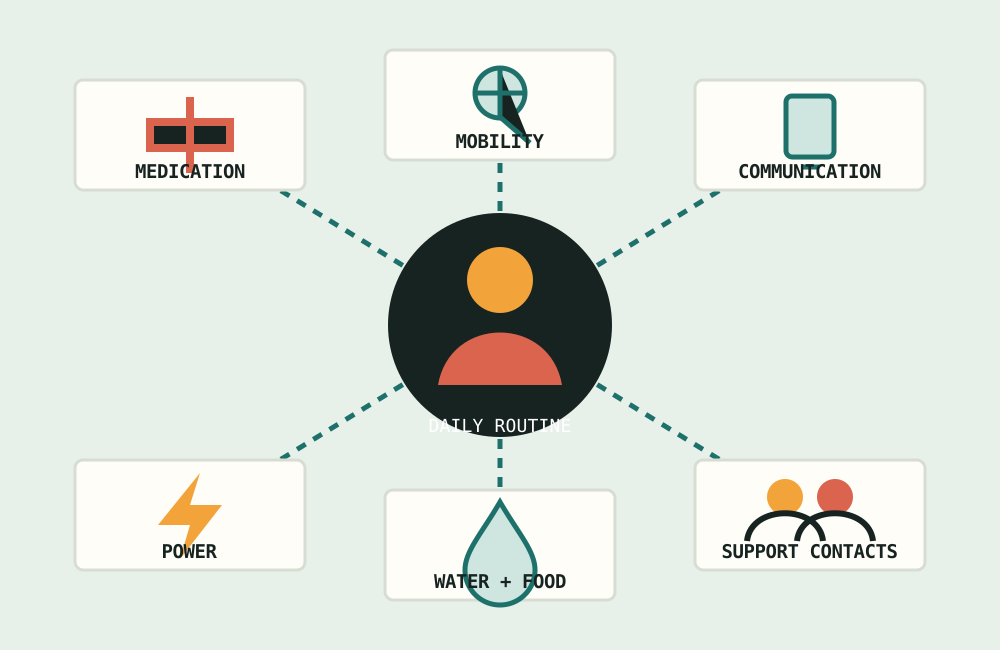
Generic supply lists are useful starting points, but they cannot see the inhaler beside your bed, the hearing-aid batteries in a drawer, the formula your infant tolerates, the route a walker needs to reach the exit, or the neighbor who helps with transportation. CDC calls these personal needs: the tools, supplies and equipment required to protect physical, mental and emotional health and safety during an emergency.
A dependency map translates those needs into a short sequence: essential activity → supporting item or service → failure point → fallback → person responsible. It does not require a shopping spree. The first result may be a phone call to a pharmacist, a printed contact card, a tested charger or a clearer place to store an existing supply.
Why a dependency map catches what a kit list misses
A kit list usually asks whether you own an item. A dependency map asks whether the entire routine can still work. A powered medical device may have a backup battery, but the backup can fail because the correct cable is elsewhere. A week of medication may be present, but the written list, refill timing or temperature plan may be unclear. A mobility aid may be ready, while the household has never tested the exit route with it.
FEMA’s Community Lifelines framework looks at services such as energy, communications, food, water, shelter, health, safety and transportation because disruptions cascade. This exercise adapts that systems view to a household. It stays intentionally small: map only needs whose interruption could create a health, safety or communication problem within the next few days.
Set the boundary: essential, daily or time-sensitive
Give everyone in the household a chance to identify what they use each day or week. Include children, older adults, people with disabilities, caregivers and anyone managing a temporary injury or recent health change. Also include service animals and pets whose feeding, medication or transport affects the household’s plan.
Start with prompts rather than assumptions:
- What medicine, nutrition, hydration or medical supply is time-sensitive?
- What helps someone see, hear, communicate, breathe, move, regulate temperature or sleep safely?
- What equipment needs wall power, batteries, fuel, cellular service or internet access?
- Who provides transportation, personal care, interpretation, reassurance or clinical support?
- What document, prescription, account number or contact would be difficult to reconstruct?
- What food, formula or supply cannot be replaced by a generic substitute?
CDC’s personal-needs guidance specifically includes prescription medicines, home-use medical devices, eyeglasses, hearing aids, wheelchairs, walkers, asthma inhalers, epinephrine autoinjectors, blood-sugar monitors, specialty foods, childcare supplies and pet supplies. The map should remain personal; no household needs every example.
Build the map in 30 minutes
Minutes 0–5: name three essential routines
Choose no more than three. Write them as actions rather than objects: “take the evening medicine,” “move from bedroom to exit,” “receive an emergency warning,” or “prepare the tolerated breakfast.” An action reveals more dependencies than a noun such as “medications” or “wheelchair.”
Minutes 5–12: trace each support chain
For each routine, ask what must be available immediately beforehand. Then ask what that support depends on. Stop after two or three links; this is a practical map, not an engineering model.
| Essential routine | Direct support | Hidden dependency | Question to resolve |
|---|---|---|---|
| Take refrigerated medicine | Correct dose kept within labeled temperature range | Working refrigerator, outage plan, temperature guidance | What written instructions does the pharmacist provide? |
| Receive an alert | Charged, accessible phone with alerts enabled | Power, cable, network, readable or audible format | What is the offline warning method? |
| Leave the home | Mobility aid and clear route | Lighting, keys, ramp or assistance, transport | Has the route been tested safely? |
| Use a powered device | Device and power supply | Compatible backup, recharge location, supplier support | How long does backup last under real use? |
Minutes 12–18: mark the single points of failure
Circle any link with no alternative. Give extra attention to a dependency that supports several routines. A single charged power bank might support communication, but it may not safely power medical equipment. A vehicle may serve as evacuation transport and a charging location, but only if it is available, fueled, outdoors when running and compatible with the equipment.
Do not count an untested item as a fallback. “There is probably a cable in the car” is an open question. “The labeled cable charged this device for 30 minutes on September 26” is evidence.
Minutes 18–24: design one safe fallback per routine
Use the least complicated option that closes the gap. That might be a paper medication and contact list in a waterproof pouch, a second compatible charging cable stored with the battery, a manual mobility alternative recommended by the care team, or two people who have agreed how to check in.
CDC recommends a contact list for people who support physical, mental or emotional health. Its disability-inclusive kit guidance also recommends considering batteries and portable chargers for adaptive equipment, communication aids, prescription medicines, medical supplies, health documents, mobility devices, and supplies for service animals and pets. Treat those as prompts to confirm needs, not a requirement to buy every item.
Minutes 24–30: assign an owner and a check date
A fallback without ownership ages quietly. Record who checks it, where it lives, and what event triggers a review. CDC advises checking disability-inclusive emergency kits every six months so contents remain current and functional. Prescription changes, a new device, a move, a new caregiver, a changed phone or a child’s growth should trigger an earlier review.
The minimum useful record
- Need: the essential action.
- Failure window: when interruption becomes a problem.
- Dependencies: supplies, power, information, people and transport.
- Fallback: a tested, safe alternative.
- Owner: the person who checks it.
- Next review: a specific date or trigger.
Rank fixes by consequence and effort
Do not score health needs against one another with false precision. Use three simple questions:
- How soon would failure become harmful or prevent communication or evacuation?
- Is there a tested alternative?
- Can a low-cost action reduce the uncertainty this week?
Complete the high-consequence, low-effort fixes first. Printing a current list, confirming a device’s backup runtime, moving a charger into the kit or asking a pharmacist for outage instructions may remove more uncertainty than buying another general-purpose gadget.
Run a five-minute verification, not a dangerous drill
Verification can be quiet and safe. Ask someone else to find the contact card. Confirm that the printed medication list is current. Test a spare cable on the intended device. Walk the evacuation route with the normal mobility aid during daylight, with appropriate assistance. Check that alert settings use a format the person can perceive.
Never interrupt essential care, disconnect medical equipment, withhold medication, deliberately expose temperature-sensitive supplies, or create an unsafe mobility test. For power-dependent medical equipment, ask the provider and utility about appropriate planning resources and backup options.
Finish with one visible improvement
A dependency map is valuable only when it changes the household. Choose one fix, complete it, and put the next review date on the calendar. Then link this map to the site’s 90-minute household risk audit: the risk audit identifies likely disruptions, while the dependency map shows which daily routines those disruptions can break. Use the $50 preparedness ladder only after the gap is clear, so limited money goes toward a verified need.