WATER PLANNING / 07
Build a water budget before buying containers.
One gallon per person per day is a starting baseline. A usable plan also accounts for pets, infant feeding, medications, cooking, hygiene, heat, lifting limits, storage space, rotation, and what happens after the first three days.
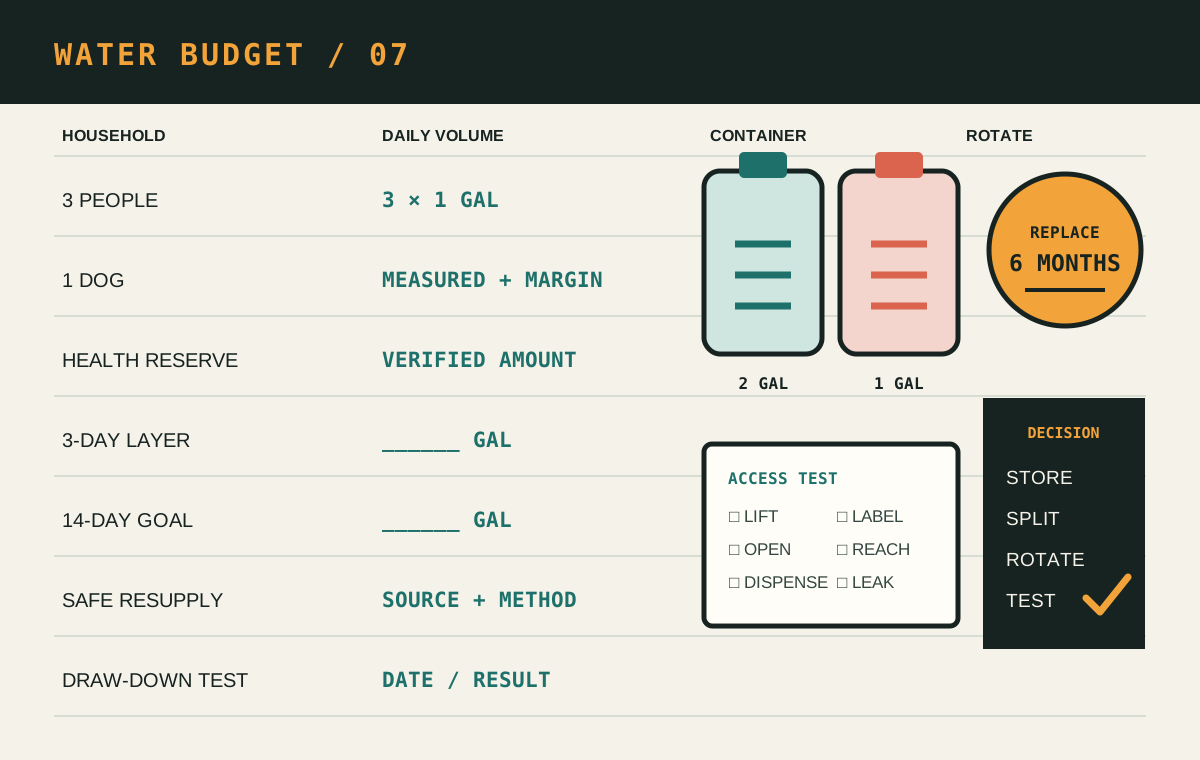
The familiar emergency-water rule is useful because it gives a household a place to begin. CDC advises storing at least one gallon per person per day for three days and trying for a two-week supply if possible. It also says to consider more for pregnant people, people who are sick, pets, and hot climates.
That baseline is not a promise that one gallon covers every household use. It is a planning minimum for drinking, cooking, brushing teeth, and other needs. A person mixing formula, flushing a feeding tube under clinical instructions, cleaning a wound, managing incontinence, or working in heat can have a different critical demand. A plan becomes reliable only when those uses are named.
People × days × 1 gallon gives the CDC baseline. Then add separately verified amounts for pets, health routines, infant feeding, hot conditions, food preparation, and limited hygiene. Keep potable and nonpotable water roles distinct.
Why this is a budget, not a target number
A budget connects a volume to a use. “Twenty gallons” does not tell a caregiver which container is reserved for drinking, whether the dog has been included, or how an older adult will lift a forty-pound jug. It also does not say what can be reduced when the outage lasts longer than planned.
Current public discussions about water storage repeatedly surface the same constraints: five-gallon containers are too heavy for some people, apartment storage is limited, rotation gets forgotten, and treatment products are assumed to remove every contaminant. Those are design problems. Solve them on paper and in a dry run rather than during a water advisory.
Start with the household risk audit. A planned utility outage, boil-water advisory, frozen pipe, contaminated well, evacuation, and regional disaster do not create the same water problem. Stored safe water helps across them, while a treatment method or alternate source may fit only some.
Step 1: list every person, animal and critical routine
Write names or roles down the left side of the worksheet. Include overnight guests, shared-custody days, home health aides, and anyone likely to arrive during an interruption. Add each pet and livestock group separately. Do not use a generic “family of four” if one person has a higher need or cannot carry the chosen container.
| Need | Who or what | Daily amount | Source of amount | Container or access |
|---|---|---|---|---|
| Baseline drinking and uses | Each person | 1 gallon minimum | CDC emergency supply guidance | Split among reachable food-grade containers |
| Pet drinking | Each animal | Record normal measured use; add margin | Veterinarian or species care plan | Dedicated labeled container |
| Infant feeding | Infant and caregiver | Exact feeding plan plus cleaning | Formula label and clinician | Safe water or ready-to-feed plan |
| Medication or device care | Named person | Procedure-specific | Clinician, manufacturer, written care plan | Small accessible reserve |
| Heat or illness margin | Affected people and pets | Household-specific | Clinician, veterinarian, public-health advice | Reserve marked “do not open first” |
Do not invent a medical-water quantity from a generic chart. Ask the clinician, pharmacist, device supplier, or manufacturer what water quality and volume the exact routine requires during an outage. Distilled, sterile, purified, potable, and disinfected water are not interchangeable terms. Record the required product and an approved substitute, if one exists.
For infant formula, follow FDA instructions and the product label. Ready-to-feed formula requires no added water. Liquid concentrate and powder require exact preparation. Never dilute formula to make it last longer. FDA advises using bottled water during a water emergency and identifies ready-to-feed liquid as a safer option than powder for higher-risk infants who are not receiving breast milk. A caregiver should confirm the plan with the child’s health professional.
Step 2: separate potable from nonpotable jobs
Safe stored water should be protected first for drinking, cooking, preparing beverages, brushing teeth, infant feeding, and any medical use that requires it. EPA says only properly disinfected water should be used for drinking, cooking, prepared drinks, washing dishes, and brushing teeth during an emergency.
Toilet flushing, some cleaning, and other non-ingestion tasks may use a separate nonpotable source if local authorities say it is safe for that purpose. Label it clearly. Never let a child, guest, or hurried caregiver guess which container is drinkable. Color, container shape, and a large written label should agree.
Boiling and disinfection can kill many microorganisms. EPA warns that they do not remove heavy metals, salts, or most other chemicals. When officials say not to use the water, follow the exact advisory. Do not assume a camping filter, bleach, or boiling makes it safe.
Step 3: calculate three layers
Layer A: the first three days
Multiply the number of people by three gallons. Add the documented pet and special-use volumes. This is the layer that should be easiest to reach, lift, and dispense. It should work without power, a pump, a strong grip, or a trip to another building.
Layer B: days 4 through 14
CDC says to try for two weeks if possible. Add volume in stages instead of abandoning the plan because the full target will not fit today. One person’s 14-day baseline is 14 gallons; four people start at 56 gallons before pets and special needs. At roughly 8.3 pounds per gallon, location and floor loading deserve attention. Keep large volumes low and stable, and ask a qualified building professional when loading is uncertain.
Layer C: resupply and treatment
Name the first reliable resupply path: official distribution site, unaffected family member, municipal notice, or another source permitted by local authorities. Then record how containers will be transported and who can carry them. Treatment is a fallback only when the source and contaminant fit the method. Print current EPA instructions and store them with the equipment.
A filter rating should name what it reduces, its capacity, flow, maintenance, storage, and certification. “Purifier” in marketing copy is not a contaminant plan. A filter that reduces protozoa may not remove viruses, chemicals, or salt. Read the current instructions and public-health notice.
Step 4: choose containers around the user
CDC says unopened commercially bottled water is the safest and most reliable emergency source. For self-filled storage, use food-grade water-storage containers and avoid vessels that previously held toxic chemicals. Containers should have a tight cover, durable material, and an opening that limits hand or utensil contact.
A five-gallon container holds about 41.5 pounds of water before the container itself. If no one can safely lift, tip, or pump from it, its nominal volume overstates the household’s capability. Several one- or two-gallon containers may cost more per gallon and use more shelf space, but they can be moved, shared among rooms, and used by more people.
- Lift test: use an empty container with equivalent safe test weight; do not strain or rehearse with an unstable load.
- Grip test: confirm that handles, caps, pumps, and spigots work for the intended user.
- Dispense test: fill a cup and cooking pot without touching the opening or spilling the reserve.
- Location test: reach the water when lights are out and the usual path is blocked.
- Leak test: place filled containers on a surface that reveals seepage without risking valuable property.
Keep water in a cool place away from direct sunlight, gasoline, pesticides, and other chemicals. Do not store a container where freezing, heat, impact, pests, or a leak would make the plan fail. Secure vehicle water so it cannot become a projectile. A car supply experiences heat and cold that may shorten packaging life; inspect and rotate it separately.
Step 5: put rotation on a real calendar
For commercially bottled water, follow the printed expiration date and inspect packaging. For water filled at home, CDC recommends replacing it every six months. Write the fill date and replacement date on every container with a marker or durable label.
Use two recurring dates already attached to household maintenance: daylight saving changes, smoke-alarm checks, lease inspections, or the fall changeover audit. Rotation should include more than dumping and refilling:
- Inspect caps, seals, handles, spigots, swelling, cracks, cloudiness, odor, and leaks.
- Confirm every container is still reachable and within the user’s lifting limit.
- Compare the household roster and special needs with the budget.
- Use the old safe water for plants or cleaning when appropriate rather than wasting it.
- Clean and sanitize reusable containers using current CDC instructions before refilling.
- Update the inventory and next replacement date.
Never dip hands, cups, or a used scoop into stored water. CDC advises using a clean device each time water is removed. A spigot or pump can reduce contact if it is compatible, clean, and stored with the container.
Step 6: run a one-day drawdown test
Do not shut off necessary water or interrupt medical care. Instead, select a safe day and mark a test quantity equal to the household’s one-day budget. Use it for ordinary drinking, one simple meal, brushing teeth, and the limited hygiene tasks in the plan. Keep normal tap water available as a safety fallback.
Record what happened. Was more water used than budgeted? Did the meal require extra water to cook and wash dishes? Could everyone open the container? Did the pump waste water? Was pet use measured or guessed? Did a person avoid drinking because the dispenser was inaccessible? Those findings are more valuable than a perfect spreadsheet.
Connect the test with the personal-needs dependency map and one-hour outage drill. A well pump, elevator, electric bottle pump, refrigerator, and building access system can turn a water plan into a power plan.
Build the budget in one worksheet
Household water budget
People: ______ × days: ______ × 1 gallon = ______ gallons baseline
Pets and animals: species / measured daily use / days = ____________________
Infant feeding or medical uses: required water and source = __________________
Heat, illness, pregnancy, or other margin: _______________________________
Three-day total: ______ gallons · 14-day goal: ______ gallons
Potable containers and locations: ________________________________________
Nonpotable reserve and label: ___________________________________________
Heaviest container: ______ lb · who can dispense it: ______________
Fill date / replace date: _______________________________________________
Official resupply and treatment plan: ___________________________________
Treatment belongs on a current instruction sheet
If stored water is unavailable and authorities permit treatment, use current CDC or EPA directions. EPA’s current page says to bring water to a rolling boil for at least one minute, or three minutes above 5,000 feet, then cool it naturally in a covered clean container. Chemical disinfection instructions depend on product concentration and water condition; use the current table and product label instead of memorized drops.
Do not mix treatment chemicals, use scented or splashless products unless current official instructions specifically permit them, or rely on expired assumptions about concentration. Keep a clean dropper or measuring tool dedicated to the method. If the source has fuel, pesticide, heavy-metal, saltwater, harmful algal toxin, radiological, or other chemical contamination, boiling or ordinary disinfection is not the answer.
What to improve first when storage is tight
- Store the first three-day baseline in sizes every user can handle.
- Add the highest-consequence special need: infant feeding, medication, pet, or heat margin.
- Split the reserve across more than one safe location when loss of one location is plausible.
- Add days gradually toward two weeks and record the total honestly.
- Verify an official resupply path and a treatment method matched to likely sources.
- Test access, dispensing, and one day of actual use.
A smaller supply that can be found, lifted, opened, rationed, and rotated is a real capability. A larger supply hidden behind furniture, too heavy to move, or dependent on an electric pump is partly an inventory number. Optimize for use.
Questions the budget should answer
How much water should we store?
Start with at least one gallon per person per day for three days and try for two weeks, then add pets and documented special needs. Treat the number as a floor to test, not a universal ceiling.
Can a filter replace stored water?
No. It still needs a source and must match the contaminant. Stored safe water covers the first period when source and contamination information may be uncertain.
How often do we rotate it?
Replace self-filled water every six months under CDC guidance. Follow the date on commercial water and inspect every container and storage location on the same schedule.
What is the best container size?
The best mix is food-grade, leak-resistant, storable, and usable by the household. Divide volume into containers the intended users can safely move and dispense.
Primary sources checked
- CDC: How to Create and Store an Emergency Water Supply — baseline quantity, two-week goal, food-grade containers, storage, access, and six-month replacement.
- EPA: Emergency Disinfection of Drinking Water — uses requiring safe water, boiling, chemical disinfection, and limits for chemical contamination; updated February 24, 2026.
- FDA: Safe Handling of Infant Formula — safe source water, exact mixing, ready-to-feed formula, and water-emergency considerations.
- Ready.gov: Water — household emergency-water planning and conservation context.
Sources reviewed October 20, 2026. Follow active public-health notices, local authorities, current product labels, and individual clinical or veterinary instructions.