Seasonal audit / 05
The 45-minute fall changeover audit.
A seasonal outlook can help you decide what to review. It cannot tell you what will happen at your address. This short audit turns a broad climate signal into five household decisions without turning uncertainty into a shopping list.
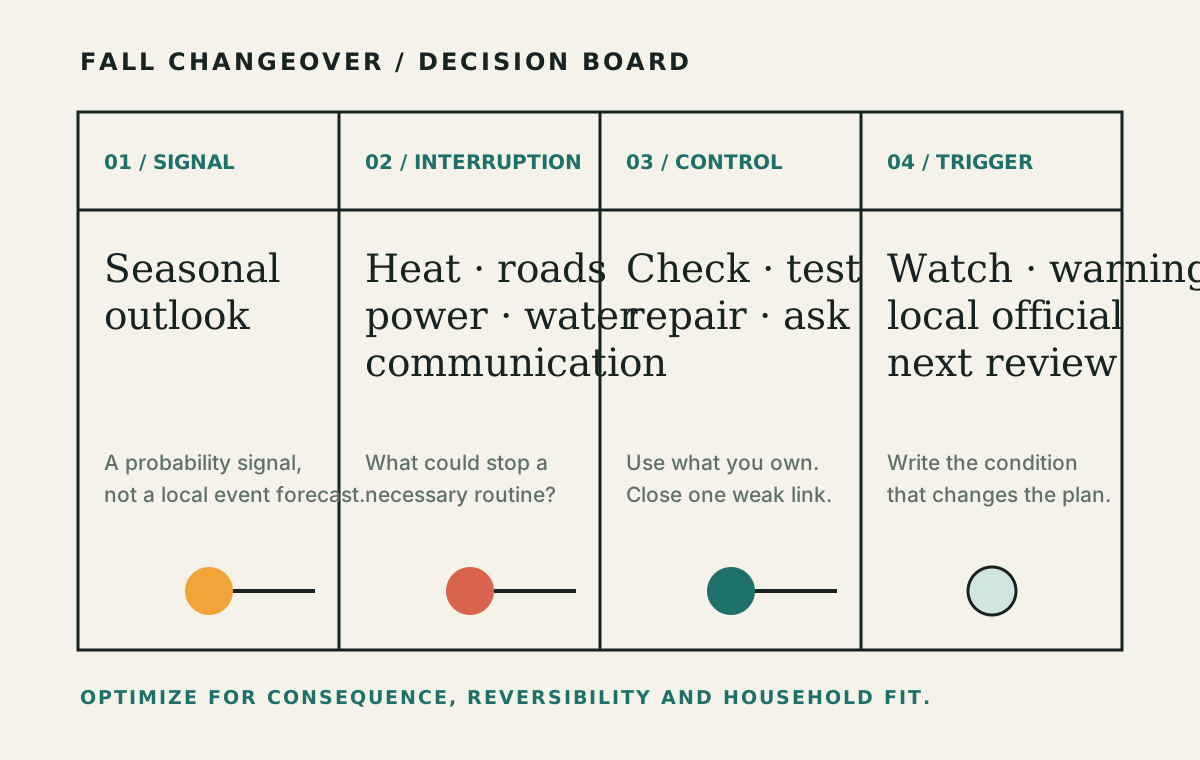
NOAA’s current October–December outlook favors above-normal temperatures in many parts of the country and describes a strengthening El Niño, while precipitation probabilities vary by region. That is useful context, but it is not a promise of warm days, a winter-storm forecast, or a reason to buy equipment. Climate Prediction Center outlooks describe how the odds of a three-month average lean compared with the historical record. They leave room for cold spells, dry weeks, storms and places where no category is favored.
The practical question is therefore smaller: which seasonal interruption would create the most consequence in your household, and what low-cost control can you check before a local watch or warning? A renter with electric heat, a rural household with a well pump and a commuter who crosses a mountain pass can read the same outlook and reach different decisions. That is a feature of a useful plan.
Before the clock starts: write two boundaries
At the top of a page, write the most important constraint and the most important dependency in your home. A constraint might be “no garage,” “$25 available,” “limited lifting,” or “one small closet.” A dependency might be “medication refrigeration,” “electric well pump,” “bus commute,” “oxygen concentrator,” or “neighbor provides evening care.” These two lines keep the audit anchored in what can actually fail and what you can actually change.
If a medical device, medicine or treatment depends on power, temperature or travel, ask the clinician, pharmacy, equipment supplier or utility about the appropriate backup plan. Do not invent storage times or operating workarounds from a generic checklist.
Minutes 0–8: translate weather into interruptions
Choose only the interruption categories that fit your location and routines. Avoid writing “winter” or “El Niño”; those are too broad to test. Write conditions such as “road home closes,” “heat is unavailable for six hours,” “well pump stops,” “phone and home internet fail together,” or “the regular caregiver cannot arrive.”
| Signal to review | Household question | Low-cost check | Local trigger |
|---|---|---|---|
| Cold, snow or ice is seasonally plausible | What necessary trip or heating routine becomes unsafe? | Check the vehicle kit, alternate route and safe indoor heat plan. | Local watch, warning, road restriction or official advice. |
| Wind or precipitation could interrupt power | Which device or routine fails first? | Charge, test and label the backup already owned. | Utility notice or local forecast window. |
| Freezing conditions are possible | Where are exposed water lines or shutoffs? | Locate the shutoff and follow property or utility guidance. | Local freeze product or property manager notice. |
| Travel conditions can change quickly | Who needs a delay, pickup or overnight alternative? | Write the contact, route and decision time on paper. | Road agency alert, school closure or NWS warning. |
“Equal chances” on an outlook does not mean “nothing will happen.” It means the seasonal average has no favored category among above, near and below normal. The correct response is to rely more heavily on local hazards, consequences and short-range forecasts, not to treat the blank area as a safety signal.
Minutes 8–18: inspect the controls you already own
Open the closet, vehicle tote or drawer. Check condition before quantity. A flashlight without working batteries, an ice scraper stored in a different vehicle, a power bank that no longer holds a charge and a contact list trapped on an uncharged phone are not current controls.
The National Weather Service recommends using fall to review vehicle winter supplies and replenish what is depleted. CDC similarly advises preparing the home and car before a winter storm, listening to forecasts and checking supplies when cold or a storm is expected. Make that guidance specific:
- Travel: confirm that the driver can reach the scraper, warm layer, reflective marker, flashlight and charger. Check vehicle maintenance against the manufacturer’s schedule and current tire recommendations.
- Light and communication: charge the power bank; test one flashlight; put a paper contact card beside the item you would carry.
- Heat and carbon monoxide: test smoke and carbon-monoxide alarms according to their manufacturer instructions. Have fuel-burning heating equipment inspected by a qualified person as applicable.
- Water: identify the main shutoff, the person allowed and able to use it, and the property manager or utility number.
- Personal needs: record which routine has no substitute and who has the authoritative answer about a safe backup.
Mark each control ready, needs service, needs an answer or not available. “Not available” is useful information. It prevents a paper plan from claiming a capability the household does not have.
Minutes 18–28: choose one consequence to reduce
Rank the interruptions by consequence, time to harm and ease of improving the control. A brief communications outage may be inconvenient for one household and dangerous for another that relies on a remote caregiver. A short power loss may be manageable until it also stops heat, water or a medical device.
Prefer an action that is inexpensive, reversible and useful under several conditions. Printing contacts helps during an outage, lost phone and rushed evacuation. Moving a charged light to the stairs helps during a grid outage and a tripped breaker. Asking a property manager where the water shutoff is can help with freezing and an ordinary leak. One verified answer can outperform another untested purchase.
Minutes 28–38: run one quiet test
Choose a test that does not interrupt care, disable safety equipment or create a fire or electrical hazard. You might find the paper road map without using your phone, make the backup contact from another device, walk from the bedroom to the exit using the stored light, or time how long it takes to find a coat, medication list and pet carrier.
If the plan uses a generator, portable heater, fireplace or other fuel-burning equipment, preparation includes knowing the safety limits. CDC says generators must stay outdoors at least 20 feet from windows, doors and vents, and gasoline-powered engines, grills and camp stoves must never be used inside a home, basement or garage. Do not use an oven or stove as space heat. Follow the equipment instructions and local requirements; a short audit is not the place to improvise combustion or wiring.
Minutes 38–45: write the trigger and review date
A seasonal plan becomes usable when it names what changes the household’s behavior. Write the trigger as an observable condition, the action, the owner and the last decision time. For example: “If the local NWS office issues a Winter Storm Watch affecting the pass, Maya checks the road agency page by 6 p.m. and decides whether to move the trip.” Avoid “if weather gets bad.”
One-page decision record
Interruption: What necessary routine could stop?
Current control: What tested capability exists now?
Weak link: What missing item, answer or handoff matters first?
Trigger: Which official notice or local condition changes the plan?
Owner and review: Who acts, and when will this be checked again?
Set the next review for a real household milestone: the next vehicle service, prescription refill, lease maintenance visit, smoke-alarm test, seasonal clock change or updated NOAA outlook. Review sooner when a forecast, travel plan, health need or household member changes.
What a finished audit looks like
A good result is modest: one control verified, one weak link named, one trigger written and one next review scheduled. It does not assume the seasonal outlook will verify at your address. It leaves the household better able to respond if a cold snap, road closure, power interruption or communication failure appears in the local forecast.
If this audit reveals several competing gaps, use the 90-minute household risk audit to rank them, the personal-needs dependency map for health and support routines, or the one-hour power-outage test for a safe rehearsal.
Sources checked
- NOAA Climate Prediction Center, official monthly and seasonal outlooks, current October 2026 and October–December 2026 outlooks.
- NOAA Climate Prediction Center, Prognostic Discussion for Long-Lead Seasonal Outlooks, issued September 17, 2026.
- NOAA Climate Prediction Center, ENSO Diagnostic Discussion, issued September 10, 2026.
- National Weather Service, Winter Weather Safety.
- CDC, Preparing for a Winter Storm, updated December 2, 2025.
- CDC, Safety Guidelines During and After a Winter Storm.
- Ready.gov, Winter Storm Information Sheet.