FOOD WITHOUT POWER / 11
Build a 72-hour no-cook food plan you can actually use.
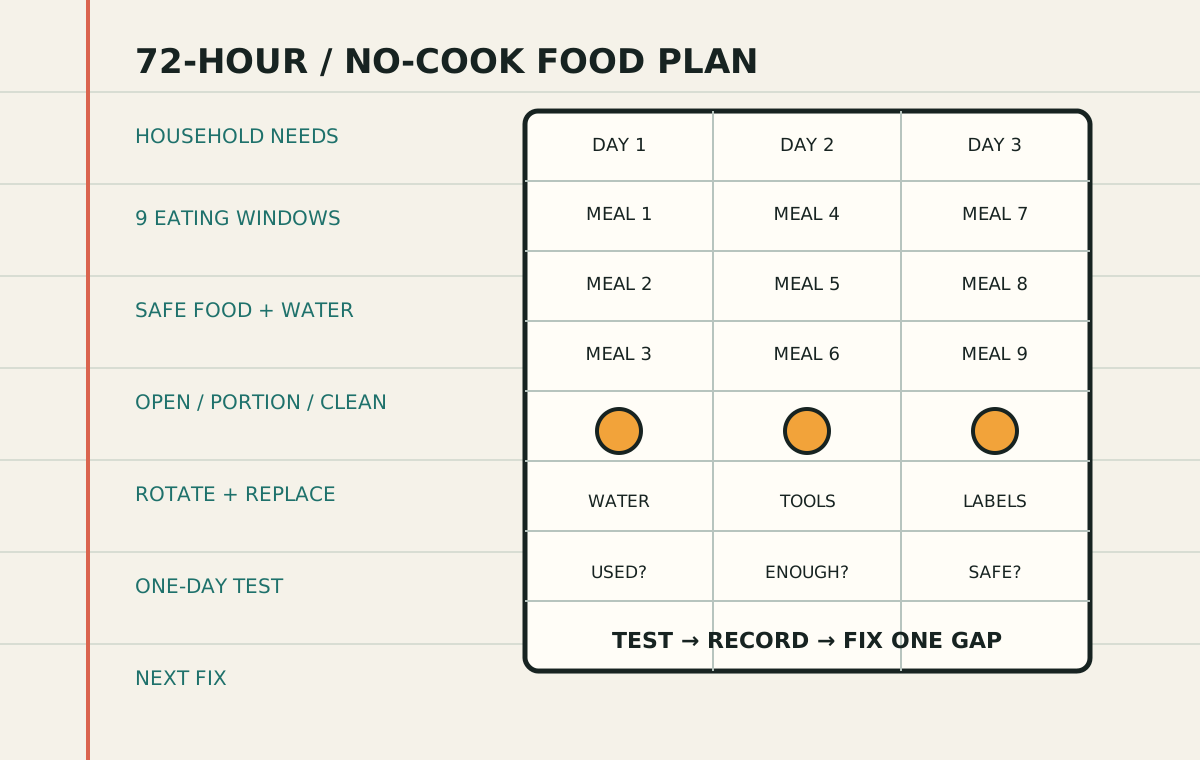
A tote full of shelf-stable ingredients is not yet a menu. Plan nine eating windows, match every food to the person who can safely eat it, count preparation water, pack the opening tools, and test one full day.
Searches for an emergency food list often end in one of two places: a commercial bucket with a servings claim, or a pile of rice, beans, cans, and snack food. Neither answer proves that the household can make a safe meal when the power is out, water is limited, a can opener is missing, and one person cannot eat what everyone else can.
Recent public discussions show the same friction repeatedly. People wonder whether long-life ration bars are simpler than a rotating pantry. Apartment residents ask how much food fits in one tote. Households with food allergies find that preassembled meals may not fit. Others discover that “shelf stable” still requires water, fuel, a pot, time, or refrigeration after opening. Those are useful research questions—not safety guidance. The plan below resolves them against Ready.gov, FDA, FoodSafety.gov, and Extension sources.
Start with the people, not the shelf life
Write one row for every person who may rely on the supply. Include allergies, medically directed diets, texture or swallowing needs, sensory needs, infant feeding, religious requirements, dental limitations, medication-food instructions, and help needed to open or portion food. Add pets or service animals to a separate food-and-water row so their supplies do not disappear inside the human total.
Do not invent nutrition targets from an online emergency list. A clinician or registered dietitian should guide a medically restricted diet, diabetes plan, kidney diet, infant feeding plan, swallowing restriction, or other condition where a change could cause harm. The goal here is to preserve an established safe routine as closely as practical for three days.
Household food constraints
People covered / location: ______________________________________________
Foods each person already eats safely: __________________________________
Allergies / cross-contact controls: ______________________________________
Medical, texture, cultural, or religious needs: _____________________________
Infant or caregiver instructions: _________________________________________
Opening, gripping, chewing, or swallowing limits: __________________________
Pet / service-animal food and water: ____________________________________
For food allergies, FDA advises reading the complete ingredient list every time because ingredients can change, even for a familiar product. A “Contains” statement is useful when present but does not replace the full list, and voluntary “may contain” wording is not used by every manufacturer. Keep the original package and label with the food. Do not rebag an allergy-safe item into an anonymous pouch.
Plan nine eating windows, not nine recipes
Ready.gov calls for at least a three-day supply of nonperishable food, adjusted to the household’s unique needs. Turn that broad recommendation into nine eating windows per person—three opportunities each day—plus the snacks or scheduled intake the established routine requires. This is a planning frame, not a prescription to eat exactly three times daily.
For each window, name a ready-to-eat combination the person has eaten before. It might pair a shelf-stable protein or familiar alternative with fruit or vegetables, a grain or other usual energy food, and a beverage or required accompaniment. The categories are prompts, not a mandatory menu. Record package size, preparation water, leftovers, utensils, and which person it serves.
| Window | Ready-to-eat combination | Person / restriction | Water | Tool | Leftover? |
|---|---|---|---|---|---|
| Day 1 / 1 | ________________ | ________________ | ____ | ____ | Yes / no |
| Day 1 / 2 | ________________ | ________________ | ____ | ____ | Yes / no |
| Day 1 / 3 | ________________ | ________________ | ____ | ____ | Yes / no |
| Days 2–3 | Repeat safe combinations or list six more windows | Verify every person | Total | Pack | Avoid when possible |
Small or single-meal packages can reduce leftovers when refrigeration is unavailable. University of Minnesota Extension recommends preparing only what is needed for one meal because several cooked or opened foods can become unsafe at room temperature. Follow the package instructions for refrigeration after opening; “shelf stable before opening” does not mean “safe all day after opening.”
Audit hidden water, fuel, and cleanup
Dry food can be compact but may move the burden into the water and fuel plans. Write down every ounce needed to mix a beverage, soften food, prepare infant formula according to its instructions, take medication, or clean a reusable utensil. Add that amount to the emergency water budget; do not quietly borrow from drinking water.
A no-cook layer should not depend on boiling water to become edible. If a food is unpleasant but technically edible cold, test it cold before assigning it to a window. If it cannot be swallowed safely without preparation, it does not belong in that person’s no-cook layer.
Prefer a low-cleanup workflow: clean hands, a clean surface, the original package, a personal utensil if needed, and a way to contain trash. Pack soap or an appropriate hand-cleaning method, paper towels if used, trash bags, and any required adaptive tool. Hand sanitizer does not remove every contaminant and is not a substitute for washing when hands are visibly dirty; follow current public-health guidance for the situation.
Pack the tools beside the food
Ready.gov specifically includes a manual can opener when canned food is in the kit. Test the opener on the exact can styles in the plan. Pull tabs can break; pouches may need scissors; tight lids can defeat weak grip; a utensil may be too short for a deep container. Do not assume another room or vehicle will supply the missing tool.
- Manual can opener tested by the person likely to use it.
- Scissors or package opener, if required.
- Adaptive grip, easy-open alternative, or assigned helper.
- Eating utensil, cup, bowl, napkin, and waste bag.
- Food-safe measuring tool for formula or required mixing.
- Glasses, task light, and written instructions when needed.
- Original ingredient and preparation labels.
- Paper inventory with replacement dates.
Keep sharp tools secured from children and store them according to their instructions. If a person cannot independently open the emergency food, record the caregiver and a second method. The personal-needs dependency map can expose that handoff.
Separate pantry food from refrigerator decisions
A no-cook supply is not a reason to gamble on warming food. FoodSafety.gov says an unopened refrigerator keeps food safe for about four hours; a full freezer for about 48 hours and a half-full freezer for about 24 hours when doors stay closed. Those times are planning guides, not permission to ignore temperature or the item-specific chart.
Keep appliance thermometers in the refrigerator and freezer. During an outage, keep doors closed, follow the current FoodSafety.gov chart, and never taste food to decide whether it is safe. Discard food exposed to floodwater and follow local authorities after contamination. Link this decision to the one-hour outage test so the household knows where the thermometers and printed chart are before the lights go out.
Use package facts, not “servings” on the front
A commercial serving count can describe portions, not complete eating windows or a particular person’s needs. Read the Nutrition Facts panel, net weight, ingredients, allergens, preparation directions, storage requirements, and manufacturer date information. Compare them with the household worksheet and clinician guidance where applicable.
Do not treat a “best if used by” date as a universal safety deadline or ignore package condition because a date is distant. USDA explains that, except for infant formula, federal law generally does not require product dating; date labels often describe quality. Follow manufacturer instructions and discard cans or packages that are leaking, swollen, badly rusted, deeply dented at seams, water-damaged, pest-exposed, or otherwise questionable.
Store the supply in a cool, dry place away from chemicals and flooding, within the package’s directions. Keep heavy containers low and within lifting limits. If the same food must also evacuate, weigh the complete module and test whether the assigned person can move it. A home stay-bin and a lighter travel module may need different foods.
Build rotation into ordinary meals
The easiest short supply to maintain usually contains foods the household already uses. Mark each item with its planned inspection month without covering the label. Put the earliest-use items where they are visible, and replace them when used. Check the module on a recurring household date and after heat, water, pest, or package damage.
A rotating supply is not automatically safe for every person, and a long-life product is not automatically wasteful. Use the method that keeps the required foods safe, affordable, available, and tested. The $50 preparedness ladder can spread purchases across pay periods: complete one person-day first, test it, then add the next.
| Item | Windows covered | Inspect / rotate | Normal use | Replacement owner |
|---|---|---|---|---|
| ________________ | ____ | ____ | ________________ | ____ |
| ________________ | ____ | ____ | ________________ | ____ |
| ________________ | ____ | ____ | ________________ | ____ |
Run a one-day test without creating hardship
Choose a calm day and use only the planned no-cook food for one person or one voluntary household meal sequence. Do not interrupt medical nutrition, infant feeding, school meals, required care, or a clinician-directed diet. Do not test an unfamiliar food on a person with allergies or a history of reactions.
- Set out one day’s three planned windows, water, tools, cleanup supplies, and written instructions.
- Use the food exactly as it would be used without power. Leave the refrigerator closed for the exercise.
- Record what was eaten, preparation water, opening difficulty, spills, leftovers, hunger or discomfort, trash volume, and time.
- Ask every participant what they would refuse by day three and what familiar substitute would fit the same constraints.
- Restore any ordinary routine, replace what was used, and fix one gap within a week.
One-day no-cook test
Date / participants: ___________________________________________________
Three windows completed: ______________________________________________
Food and drinking water used: __________________________________________
Tools or assistance needed: ____________________________________________
Allergy / label / cross-contact check: ___________________________________
Leftovers and trash: __________________________________________________
Food refused or poorly tolerated: ________________________________________
One replacement or system fix: _________________________________________
Owner / due date: ____________________________________________________
After the day test, extend the paper plan to all nine windows and verify the full quantity. Another responsible person should be able to locate the module, identify which foods belong to whom, find the water allocation, open the packages, and name the rotation date without using a phone.
Questions people ask while building the tote
What belongs in a three-day emergency food supply?
Foods each person already tolerates that are shelf stable, require no refrigeration, and can be eaten without cooking. Plan them as complete eating windows, keep labels, include opening tools, and count preparation water separately.
Does every emergency food need to be no-cook?
No, but the first short-term layer should work without heat. A separate tested heating module can expand choices when fuel, ventilation, weather, mobility, and fire safety allow it.
How should allergies be handled?
Use previously tolerated foods, read the entire ingredient list every time, retain original labels, prevent cross-contact, and follow the established treatment and emergency plan. Do not use an emergency to trial a new product.
When should the food be replaced?
Use the package date and manufacturer directions together with storage conditions and normal household rotation. Inspect on a scheduled date and immediately after heat, water, pests, or damage.
Primary sources checked
- Ready.gov — Build a Kit — several days of food, household-specific needs, water, and a manual can opener.
- FEMA Ready.gov — Are You Ready? An In-Depth Guide to Citizen Preparedness — separate home, work, and vehicle supplies; food, water, medication, infant, and pet needs.
- FoodSafety.gov — Food Safety in a Disaster or Emergency — refrigerator and freezer time windows, thermometers, ice, flood exposure, and discard decisions.
- FDA — Have Food Allergies? Read the Label — full ingredient review, major allergens, advisory wording, and changing formulations.
- University of Minnesota Extension — Preparing Food Without Power — no-cook options, limited water, one-meal portions, and food-safety constraints.
- USDA FSIS — Food Product Dating — federal dating rules and quality-versus-safety context.
Sources reviewed November 17, 2026. Public discussions were used to identify recurring questions about ration bars, pantry rotation, small-space storage, hidden cooking water, sodium concerns, and allergy-safe food. The plan and safety boundaries were resolved against official and Extension guidance. Follow current package instructions, public-health directions, and an appropriate clinician’s advice for medical nutrition.